On the thirteenth day of our Ultimate Alaska Cruise, we visited Glacier Bay National Park, one of the highlights of the cruise, and checked out four huge glaciers up close and personal. Or as close as we dared approach.
We woke up bright and early, as usual. We dressed for cool springtime coastal Alaska weather, which meant several layers, including a windproof one on top. It was breezy on a moving ship, even though the weather itself was quite calm. In fact, the clouds of the sunrise were gorgeous.


As we arrived at the mouth of Glacier Bay, another cruise ship, the Celebrity Summit, took up a position ahead of us and to starboard. They, too, were headed for the park. A small aluminum catamaran approached from the mainland, and interacted with the other ship, then came over to ours. They pulled up alongside and discharged several National Park Rangers and some gear. Nice! Apparently, part of our passage payment went to the park for admission purposes. We also got to have a knowledgeable, authoritative voice on the loudspeakers, so we could all learn about the park.


At this hour (6 am) the air was still quite cold. The bay was also very calm, and we even got reflections of clouds and sky and mountains as we glided silently forward into the bay. The ship had a coffee stand up on the Sun Deck, complete with every kind of alcoholic liqueur that might reasonably be added to coffee. To make the passengers feel warmer, of course.


The air was cold and there were icy-looking clouds floating along, midway up the nearby mountainsides. We steamed on, listening to Ranger Dani whenever she found an interesting item to see along the way. One of those items were some mountain goats. They were hanging out on a rocky outcropping called Gloomy Knob. The captain took the ship closer so that we could see them as we cruised on by.


The next item to see, on the port side, was Reid Glacier. It was an eleven mile long glacier that extended inland to a high ice sheet, far beyond our eyesight. It was named for Harry Fielding Reid, a geophysicist and glaciologist and professor at Johns Hopkins, by the members of the Harriman Expedition who also named the glaciers in College Fjord. They were a busy crowd, and they got to name so many things! There’s hardly any of that sort of thing left for the rest of us nowadays, sadly. Although I have to admit that I’ve attempted to name a few things myself, deep within the High Sierra, but without much success. It would probably help if I funded a scientific expedition into a hitherto unexplored region of the planet.


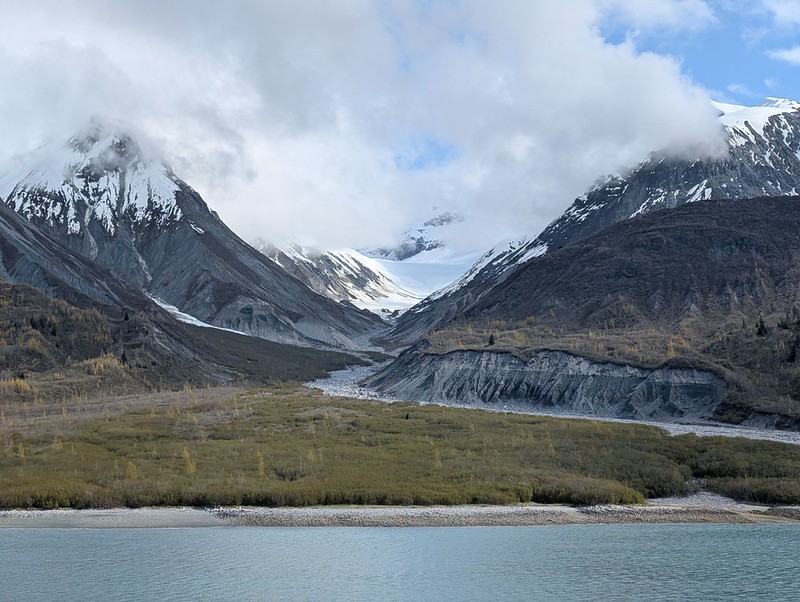
After passing the Reid Glacier, we entered Johns Hopkins Inlet, and began an extended viewing of the Lamplugh Glacier. It was nestled in a valley next to dramatic-looking Mount Cooper, which was swathed in wreaths of cloud, its snowy summit shining in the sunlight.


We were hoping to head deeper into the inlet, in order to view Johns Hopkins Glacier, but the park rangers didn’t allow it at this time. I’m not sure why. So we hung out for a long time near the Lamplugh Glacier, which had receded in recent years, and was no longer considered a tidewater glacier. We could see chunks of calved ice on the shoreline below its face. Some parts of it were dirty with rocky debris, and others were a lovely blue color. There was also a much smaller vessel (yet still huge from a personal ownership point of view) which was moored near the base of Mount Cooper. This ship sent a small inflatable boat toward the glacier, and landed in front of it. OK, I’m not going to lie. I was totally jealous. It looked like a privately-funded scientific expedition!
It really put into perspective just how huge those tiny chunks of ice were near the water. Amazing.


We spent quite a bit of time near the Lamplugh Glacier. In retrospect, I think we were waiting for the other Cruise ship to finish viewing the other glaciers at the far end of the bay. But that was fine. The weather was wonderful, without wind, and we were in an amazingly beautiful national park. Hanging around longer was hardly a chore!


This was when I decided to go check out the Glacier Bay National Park “Store” that some of the rangers set up on board. It was in one of the lounges near the stern, also high up on the Sun Deck. The rangers were selling various books and souvenirs, and also dispensing knowledge. All was as it should be, because you can’t really land the ship to visit a gift shop at this park!


As we headed north into the Tarr Inlet, we were treated to plenty of shoreside beauty. Ranger Dani even spotted a Brown Bear along the shore. Everyone crowded onto the starboard side to get a glimpse. It was very far away, and my phone was barely able to make it out as it walked along a gravel beach.

Finally, we arrived at the far end of the park. We could see the Grand Pacific Glacier ahead of us. It receded from the water long ago, and now there was plenty of dirt and rock in front of it. In fact, it had almost receded as far as the Canadian Border. In other words, Canada was right in front of us! We glided up on it, and allowed the other ship to sneak past us. They were probably headed for the Lamplugh Glacier.


Also at this end of the inlet was the Margerie Glacier. This glacier still had its toes in the water, and there was quite a bit of glacial ice floating on the surface, which the ship slowly nosed its way through. Interestingly, Margerie Glacier is currently stable, neither advancing nor retreating, as its ice is fed from the massive snowfall on Mount Fairweather, a 15,000 foot peak that defines the border of Alaska and British Columbia in this region. The Johns Hopkins Glacier (which we didn’t get to see) receives that same snowfall, and is actively advancing at this time. As is usual with climate change, some glaciers grow while others retreat, even if most are retreating at the current time.


The captain spun the ship about, just as he had at the Lamplugh Glacier, in order for the passengers in the exterior staterooms to get a good long view. Let’s face it: Margerie Glacier was the star of the day. If it had let loose a huge chunk of ice we would have been ecstatic. But you can’t have everything. I decided that the fine weather was more than enough to make up for it.


As we headed south, the afternoon breeze picked up, and the bay was no longer glassy-smooth. The wind from the ship’s motion was also a factor. That’s when we went to the buffet to eat some lunch. We could still see out the window, but didn’t have to deal with the breeze. The captain announced that the park rangers would be leaving the ship on the starboard side. I decided to head down to the Promenade Deck to view this operation. And it turned out, I chose the perfect spot along the rail, and got to see everything. Jumping from one boat to another is always a bit risky, but these folks were pros. It all went off without a hitch, and everyone waved goodbye as they headed back to their headquarters.


We went back to the stateroom and took a nap. Then we got up and ate dinner at the buffet, rather than our usual restaurant. We really wanted to enjoy the Alaska coastline, while we still had it. We knew that we’d be heading south in a day or so, and we wanted to see everything.


We eventually had to go to bed, but not until we were heading out to sea once again. We had to leave the Inland Passage and duck back in again further south, in order to visit our final Alaskan destination: Wrangell.
For a topographic map of the cruise see my CalTopo Page
For LOTS more photos of the voyage see my Flickr Page
 << Back to Day 12 Onward to Day 14 >>