
From PCT mile 779.9 to 789.7 Total: 11.9 miles 7/7
On my 15th day hiking the Sierra Section, I climbed up and over Forester Pass, at 13,200 feet elevation, continued north through the Bubbs Creek valley, climbed yet again to the Bullfrog Lake Trail turnoff, and headed east to the Kearsarge Lakes area, as I was nearly out of food. I planned to slackpack over Kearsarge Pass the next day to retrieve my resupply cache in Onion Valley and be back on the PCT by nightfall.
I woke up that morning just after 3am and started my usual routine of eating, dressing, and packing. I wanted to reach the top of the pass early, so the snow on the north side would be icy, but not so early that there wouldn’t be any light for photos. This is a photojournal, after all, and “photo” is the prefix of the word. But I will admit that it was barely dawn when I left, and my headlamp wasn’t merely turned on; it was actively lighting the trail! So up the hill I climbed.


The hiking was slow and steady, with many switchbacks. This southern face of Forester Pass was particularly steep compared to the north side, where the land sloped away more gradually. This trail was really hacked right out of the near-vertical granite headwall of Tyndall Creek Canyon. The views of the high lakes below me got better as I climbed, and soon the light of sunrise began striking the eastern sides of Caltech Peak and the distant Kaweah Range. It was a great morning to be in the Sierra.


I wasn’t exactly blazing a trail up that hill, but the air was cool and I was hiking steadily. I felt good. Soon, I was nearing the most interesting part of the climb, where the trail was truly hacked out of the cliff, possibly using dynamite in the olden days. It traveled west, crossing the scary chute of loose scree and residual snow, just below the pass itself.


I came down this trail on my way to Mount Whitney back in 2018, and I knew that the long traversing switchback was the most exciting part. This time, I got out my GoPro camera and filmed the event as I hiked along. Luckily, I waited long enough this Summer that the snow was no longer a danger. Note that the wide-angle GoPro also makes it look more exposed than it really is. The trail was plenty wide enough to hike on safely. Not that you shouldn’t pay careful attention to avoid falling off the edge by accident! There are no handrails in the Wilderness, after all, and the risks are yours to dare.


Interestingly, the trail builders decided that it would be easier to add a few extra shorty switchbacks on the western side of the pass. These led up and over a bump to reach the true pass, where the signs were placed which denote the boundary between Sequoia and Kings Canyon National Parks. Once again, I whipped out the GoPro and videoed everything. I was also taking photos with my phone camera at the same time! No, I didn’t use hiking poles – there were too many awesome views to document!


The sun hit me full blast as I arrived at the pass. It was exciting to know that I was at the highest point on the PCT. Of course, I was also on the JMT, whose highest point is Whitney’s summit, but that’s merely a detail. This was one of those places that is truly memorable, so I took off my pack for a quick break. I looked down toward my morning’s camp, and there was Felipe (and the others) still getting ready to start. Yes, I got the jump on them, but I knew they’d catch me soon enough, as they were younger and faster. I’m older and trickier, and I need less sleep than they do.


Thanks to the bright sunlight, I knew that I couldn’t stay on the pass very long. I had been carrying a pound of MicroSpikes in my backpack, and I fully intended to put them to use! That, of course, was the real reason I woke up so early. MicroSpikes work best on crunchy, icy snow. Once it gets slushy via melting they are rendered essentially useless. I knew about the few remaining snow patches up here, and I knew that they would refreeze overnight. The trick was to arrive early enough to use the spikes, which are actually kind of fun.

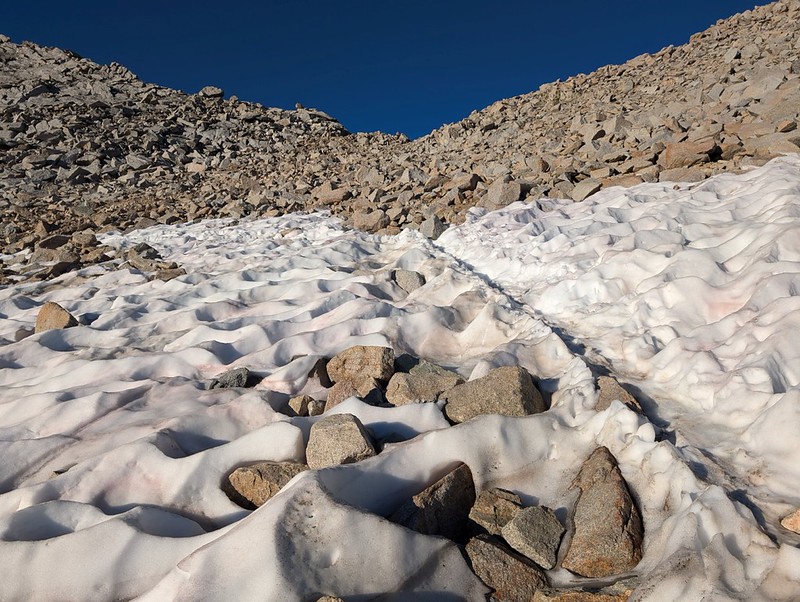

After the excitement was over, I took off my pack, hung the spikes to dry on a strap, then continued onward down the trail. Soon, I came upon another melting snowbank, a cornice on a broad ridge. This time, like a fool, I decided that it was too short to bother putting the spikes back on. Wrong! It only looked short. I ended up balancing carefully in icy suncup depressions for far too long. It was a risk I shouldn’t have taken, in retrospect, although my balance was good and nothing went wrong. The snow was only starting to get slushy, but was still too icy in shady spots. Scary but true.


After that, I paused for a few minutes, to get my attitude back into shape. I took a number of photos of the distant mountains to the north. This was the time to do it, while I was still up this high. You don’t hike at 13,000 feet very often, so use it while you’ve got it!


I continued downhill into the valley. I had about 3600 feet to descend over the next eight miles, and it was going to take me at least four hours.
The final snowbank was much shorter, but this time I put on the spikes and was happier for it. Sliding down the hillside into rocks, without an ice axe to self arrest, would have been a bad idea. But the spikes and my walking stick did wonders. I passed by the large lake below the pass, and also another smaller tarn. It was very beautiful, and the air was still cool and fresh.


The trail continued down through the above-treeline tundra vegetation, and it was smooth and cruisey. Easy hiking. There was still enough snowmelt to keep the creek running, although crossing it was trivial this high in the canyon. I remembered coming uphill on this trail, and I enjoyed climbing it. Descending was even better.


Eventually, of course, I began to tire, even on a great trail. I stopped for an extended break, and let my socks dry out a bit. I read my Kindle and enjoyed the view. Soon, I would be entering the forested section of trail below 11,000 feet, but right now the sun was rising and I was getting warm. I was getting ready to start my mid-day shade-hopping hiking style, where I walk extra fast in the sun and pause for breath in shady patches.


After Felipe passed me, I decided to take yet another extended break to do a bit of fly fishing in Bubbs Creek. I was only hiking twelve miles at most today, so I had time enough for fun. I spotted a big boulder next to a deep pool on the creek, and knew that this was the place. My new PCT Sierra Trout Guide indicated that there should be Golden-Rainbow hybrid trout living here. Time to put the hypothesis to the test!


I caught a fish within five minutes, then decided that this was enough. I wasn’t eating them, after all. That was Vicki’s job, but she was at home this trip. Twelve to fifteen mile days with lots of climbing weren’t her forte, so we parted ways for a time this Summer.
After that, it was time to continue downhill along the creek, which by this time had been growing larger with the cumulative sum of all the side-creeks tumbling down from the steep canyon walls and valleys. It was roaring, and I was glad that the trail didn’t have to cross it.


It was a bit past noon when I reached the campsites near Vidette Meadow, so I stopped for a lunchbreak in the shade. This was one of the old-time camps along the JMT, and still had a big steel bear box for food. Nowadays, all backpackers are required to carry their own bear canisters, so these boxes are redundant. I remembered meeting a short French hiker in the late 90’s who swore that he slept (curled up) in the bear boxes during thunderstorms! Crazy but true.
Near this camp, taped to the official trail sign was a note from the local backcountry ranger, about bears. Apparently there was a “nuisance bear” hanging out here and in in the Kearsarge Lakes area, which was where I was headed. “Great!” I thought. “Just what I needed!” The Ranger’s Words of Wisdom were as follows:
“If you see a bear, chase it like you are going to catch it and eat it. They will run away in terror. Loud noises can help, but only sorta work on their own.”
Well, at least I knew what to do. Loud noises used to be good enough, but no longer. It was time for us hikers to become the scary ones! Total role reversal. For some odd reason, I liked this idea.


After that, I continued beyond the trail junction, where my climb out of Bubbs Creek began. It was going to be a long hot climb in the afternoon sun. I knew that this would happen when I planned this hike, but it didn’t make it any easier. Along the way, I got better views up the Bubbs Creek Canyon that I just descended. I also met up with Felipe one last time. He was planning on hiking all the way out to Onion Valley today, in order to take a full Zero Day and meet his father, for a stay in Lone Pine. I was popping over Kearsarge Pass to Onion Valley tomorrow morning and would be hiking back to the PCT the same day, after picking up my food resupply, so there was little likelihood that we would meet again on the trail. I said so long, and we promised to email each other afterward. (And we did!)


I left the main trail at the top of the hill at PCT mile 790, and turned right (east) onto the Bullfrog Lake Trail, which stayed down in the Kearsarge Basin. The first stop was Bullfrog Lake itself. After years of overuse, camping was banned within a quarter mile of this lake. So now it was quite pristine, and perfect for tent-free photo-ops.


This time, I didn’t stop to fish in the lake, as I had already done that two years earlier, back in 2022. My primary goal at this point was to make it to a campsite at the Kearsarge Lakes. Naturally, after hiking around the lake, the trail was uphill all the way in the hot sun. I trudged along, pausing in the shade of the occasional pine tree, and eventually remembered to turn around and check out the fine view of Bullfrog Lake from further up the basin. Nice!


The final climb to Kearsarge Pass was tomorrow’s problem, so I headed downhill on the small side trail toward the nearest of the Kearsarge Lakes. I’ve camped there several times, and it was a popular spot. Not only is it a single-day destination for weekenders, it’s also a great spot for trout fishermen, as the lakes are full of Brookies. I wandered around the upper end of the lake looking for a campsite, rather than hike further, because I had to hike out early the next morning. I found a spot in the shade of a low pine and set up camp. I’m not gonna lie when I say that it was a relief to take off my backpack.


One of the lady hikers from last night’s camp ended up right near me, so we said hello and talked about resupplies. She had never been here before, so I told her how pretty the trail was over the pass to Onion Valley, with its chain of lakes and fine views. While I spoke, I saw movement out of the corner of my eye. It was the bear! It was sidling along near our sites, eyeballing our gear for a chance to steal some food. Bad bear! Its fur was all patchy, as if it was half-shedded, and it really was a sorry sight. It also seemed kind of sheepish, like it knew that what it was doing was wrong, but it couldn’t help itself. That was my impression. But that didn’t matter. I remembered the note from the Ranger, and I immediately implemented the advice. I raised my arms and waved them over my head, yelling “Yaaahhhh!!!” as I charged toward the bear, intent on eating it! And, amazingly enough, it ran away! This encouraged me greatly, as you might imagine. I decided that the best idea was to keep on chasing it until it was very far away. I knew that there were more campers elsewhere along the lake, but at a certain distance I felt that my work was done. The bear was somebody else’s problem now.

My neighbor was still sitting in her tent when I returned. I guess she wasn’t interested in grilled bear meat. But she was still thankful that the bear was gone, and both of us made sure of our food storage that evening, by securely closing our bear-proof canisters.

After that excitement, I was truly tired. I sat down in the tent and cooked up my last dinner of ramen noodles, and munched on some salty chips. Tomorrow I would get resupplied with another six days of food, so anything left in the can was fair game. I munched what I could and went to sleep with a full belly. Tomorrow I would wake up early, as it was going to be a very full day of hiking, and I was looking forward to visiting Kearsarge Pass and Onion Valley once again.
For a topographic map of the hike see my CalTopo Page
For LOTS more photos of the trek see my Flickr Page
 << Back to Day 14 Onward to Day 16 >>

 hikingtales.com