We changed our plans and headed to Olympic National Park, and backpacked on the North Coast Trail from Rialto Beach to Hole In The Wall and the Chilean Monument. Our original plan was to hike parts of the PCT, but there was still significant snow above 5500 feet, so I devised a way to let that snow melt for a week or two. We once hiked to a few locations along the Pacific Ocean in Olympic NP, back in 2022, and I thought that we could do more of it now. We love camping on the beach. Listening to the waves at night is very peaceful.
So, after reserving wilderness permits and camping spots along both the North and South Coast Trails, we drove northwest to the coast. We stopped along the way to print the permits, then spent the night at the Mora Campground in Rialto Beach. It was a peaceful campground. We got our gear ready for tomorrow’s hike, and headed to bed early. We also took photos of the daily tide chart, which was posted near the trailhead. Tide height is very important, as there are places that have tide restrictions, meaning that you can’t pass if the tide is too high. Timing is everything on this trail.


The weather forecast called for a chance of showers in the morning, which didn’t make me all that happy. Our plan was to leave the car at the far end of the hike, near Shi Shi Beach, then ride my small motorcycle back to the trailhead down south. We drove down to Rialto Beach and stashed the heavy backpacks out of the rain behind the bathroom. It was a 90 minute drive. Each way. In the rain. On a motorcycle! But that’s what I had to do, and Vicki had to sit around waiting, bored to tears, while I did it. Good thing I had rain gear. And she had a book to read.


I kissed Vicki goodbye and headed north. Yes, it took the full 90 minutes. Then I had to pay for parking, unload the motorcycle, and drive home. My Honda GROM is only 125 cc, and its top speed is 55 mph. So you can imagine that it was a bit scary during the ten miles of highway 101 with cars going 65-75. I pulled onto the shoulder to let them pass again and again. And then it rained. More than once! It was showery weather, so most of the time it was fine, although I definitely got drenched, even with my raingear. But I made it back safely. Four hours later. Poor Vicki. At least I had something to do.


By the time we started hiking, it was sunny and beautiful. Truly a lovely day on the beach. There were tons of dayhikers, and all of them were faster than us, but we didn’t care. We were the ones camping on the beach tonight! So we headed north with happy hearts.


Luckily for us, the tide was low enough to pass through the famous Hole In The Wall, which pierced a rocky promontory jutting out into the sea. There were dozens of dayhikers present, all checking out the nearby tidepools and taking photos like mad. It was one of those extra-picturesque locations along an already picturesque coast. We passed through and continued on a short ways. We found a likely boulder and used it as a seat. We took a short break and relaxed.


Eventually, we put on our backpacks and hiked onward. This section was easy to hike, with flat rocks (thanks to the low tide) and also some sand and gravel beaches. The gravel made walking a slog, but we’ve learned the trick of avoiding having our feet sink into the tiny shifting stones. It’s sort of a shuffle, using small steps. Those who stride too large also sink too deep.


But that didn’t help when we came to the next point of land. Now the shoreline was covered in large boulders. Most of them were rounded and worn due to the action of the waves. They were liable to shift or roll if you stepped on them carelessly. This slowed us down. Climbing over larger rocks on the point itself was mostly a matter of scrambling and route-finding. Just to keep things interesting, in some spots the fastest way to hike was to stay on the flat “foreshore” rocks which were covered with water at higher tides. These were coated in seaweeds: some brown, some green, some leafy, and some slimy. Hiking here was fun, but it required constant vigilance to avoid landing on your butt. And none of it was fast.


Along the way there were many Sea Stacks. These are tiny islands that stand just offshore. Sometimes they can be reached at low tide, and others remained out in the ocean. Seabirds liked the true islands, to keep safe from four-legged predators. We passed a point on my map that was tide restricted at the five foot level. Hole in the Wall was a six foot zone, by comparison.


By the time we began getting close enough to our campsite at the Chilean Memorial, Vicki was already feeling extremely tired. Weak, even. She was often tired, but not weak, as she had plenty of willpower. This was unusual, and a bit concerning. So we slowed down a bit more. I tried to point out the location of the camp, as there was already a tent there, off in the distance, in order to raise her spirits. Naturally, her hopes were soon crushed by yet another point of land. This one had large blocks of stone piled randomly, plus a few huge logs of driftwood barring our path. It wasn’t an easy stretch to cross. And we slowed down even more.


The “trail” finally relented and there was some mellow beach to hike for the final quarter mile. With only a few giant logs of driftwood to surmount. It was almost six o’clock when we arrived in camp. Four miles in six hours wasn’t exactly an awe-inspiring pace. But we made it. I picked out a spot as Vicki was too whupped to even think. I set up the tent, blew up the air mattresses, and sent Vicki inside for a nice lie-down. Then I went over to the nearby flow of fresh water that fell to the beach in a tiny trickle. It was enough, and I filtered two gallons. That would be plenty for tomorrow’s hike.
After that, Vicki woke up and felt a bit better. We viewed the plaque for the Chilean Memorial, which was about a shipwreck that happened here back in 1920, over one hundred years ago. This area was often called “The Graveyard of the Pacific” due to the fierce storms and thick fogs. Thank goodness for GPS! Such wrecks are rare now.
We hung out on the beach and ate some dinner. We spoke with a few neighbors, but we mostly kept to ourselves. The good thing about camping on the beach was that the waves drowned out the yakking from loud hikers. Being near a burbling brook served the same purpose. Later on, the air got cool and the sun lit up the clouds with a bit of color. We decided to go to bed early.


In the tent, under the sleeping quilt, I asked Vicki how she was feeling. She still felt weak, she said. The nap hadn’t cured her like it usually does. I fired up my CalTopo App and we checked out the plan for tomorrow. We also looked at the tide table. It was seven miles to our next campground. At our current one mile per hour-and-a-half pace, this would take us almost all day. Plus, there was a bump of high tide in the middle of it, where we might have to wait out a restricted zone. The following days’ tides were worse, as the lower low tide would be happening well before dawn. In other words, I was getting worried that Vicki wouldn’t be able to make it, that she’d get weaker, not stronger. I asked her point blank what she wanted to do. Should we head back? Or keep on going for six more days? She didn’t know, so we decided to put off the decision until morning.
We woke to the sound of drizzle pattering on the tent. We could see from beneath that it was coated in drops. I got up to take some photos and discovered a cloudy, misty world, with a very low tide and the sea far away. I didn’t stay out there long. I asked Vicki how she was feeling. She still felt tired. I realized that there was no way she was going to crank out seven miles, so I made the call to quit the trek, to head back to the beginning. It wasn’t an easy decision, and it made both of us sad. But there it was. So I got back under the goose down and the two of us fell asleep once again.


Eventually the rain stopped, and Vicki slept on while I read my kindle lying next to her. She eventually woke, and we decided to eat some breakfast and pack up our gear. The tent was still soggy but I didn’t care; I’ve carried soggier ones in the past. I keep it in its own plastic bag, away from my important gear. We could dry it out later. Then we put on our backpacks and headed south. The North Coast Trail had defeated us.


Just to be different, we decided to try out the “inland” trail that bypassed the really big rocks on the nearby point of land. There were knotted ropes attached to tree up above us, to help us climb and descend the steep dirt embankment at each end. Naturally, the inland path was full of fallen trees and other obstacles, and probably took us at least as long as the rocks would have.


We slowly retraced yesterday’s steps along the rocky coastline. Some parts were coated in seaweed, and others in rocks, or gravel. We were getting used to this. Luckily, the marine layer clouds remained above us, so we didn’t roast in the sun. We were thankful for any help we could get.


We passed the cliff section where the tide had to be less than five feet. There was no way to pass it otherwise. Unless you liked getting soaked, and the waves that soaked you were small enough that they wouldn’t sweep you off your feet. Once that was over, the only other problem was Hole in the Wall, and there was a crazy inland path over that.


After that, it was more of the usual. But we were used to it, so we just took it easy. We even took a long break, as Vicki was feeling a total lack of energy. I tried not to push her, as she was pushing herself hard enough for both of us.
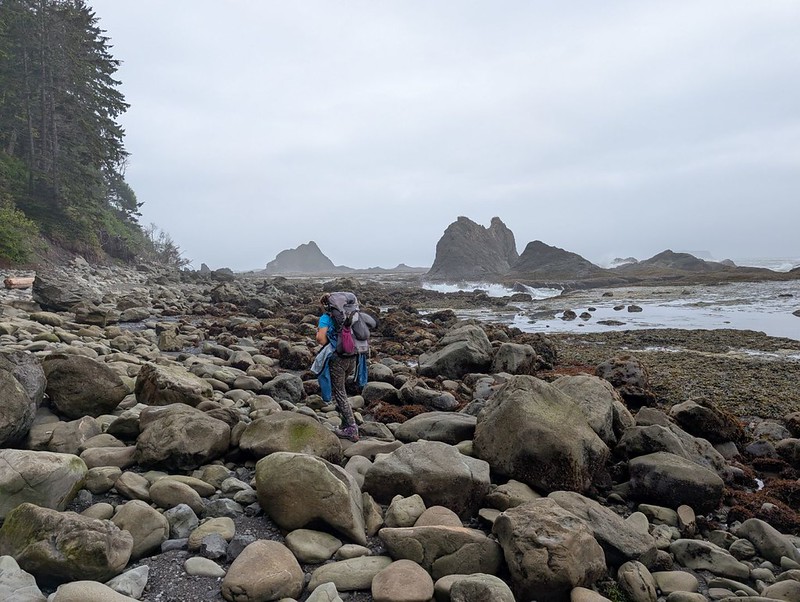


Once we rounded the rocks on the last point of land, we were home free. Vicki decided that she wanted to stop at Hole in the Wall that night. I was OK with that. At least I got an extra night at the beach. And the snow still hadn’t melted up on the PCT, so why rush?
We remembered that the water source was on the north side of the campsite, so we stopped to filter a gallon or two. That would be enough to easily get us back to Rialto Beach. By this time, the sun was shining, so Vicki stuck her head under the icy trickle of fresh water and cooled herself off.


We walked along the easy stretch of beach to the campsite. It wasn’t far. As we neared it, we saw two tents already there, high above the tide line, within the huge driftwood logs. Just looking at those logs was enough to make you scared of ever being out here during a big Winter storm. Anything that could toss those multi-ton monsters around was a force to be reckoned with.
We said Hi! to our new neighbors. They were two women, camping with their two young sons. The kids were having a fine old time. I set up our tent in what I hoped was a safe spot (they already got the best spots) and Vicki had fun being chased by the two pretend “monsters” around, over, and behind the nearby driftwood logs. Everybody had a lot of fun. And the two moms got a needed break. Those kids had energy!


The tide came in as the afternoon progressed. There also appeared to be some decent-sized waves. They looked small when they were far away, but not any longer. Soon, the tide was above six feet, and the hole at Hole in the Wall was awash in water. There would be no more day-hikers today. We ate our dinner and watched it get closer. And closer. And closer. It was relentless.
Soon, we noticed that there were hundreds and hundreds of jumping bugs climbing up and over the logs protecting our campsite from the waves. They were sand fleas, each about a half inch long. Soon, they were crawling all over the tent in their mad rush to avoid the ocean. We dove into the tent and zipped up the screen. Those suckers were everywhere! Luckily, they didn’t bite, so it was easy to remove the ones that got inside before we realized what was happening. It turned out that they only wanted to travel in one direction: Away from the sea. So we were able to enter and exit the tent from the far door.
We put on evening clothes and our wind breakers, and hung out outside the tent, just watching the waves. The two “monsters” had no way to reach us now and stayed with their moms. I got out my phone and checked the tide chart. The highest high tide was due to peak at 9:30pm, and it got dark about 10pm. So we stood outside the tent and waited, praying that our gear wouldn’t be swept away or inundated with salt water. Every seven waves brought a new set, or “significant wave” (or pair of waves) that was the largest of the series. We kept watching the most likely spot where Doom would arrive. The big logs in front of us were solid; it was the angled path on the right that was the danger.
In the end, the waves got within five feet of the tent. Once ten o’clock arrived, I declared the emergency to be over, and we retired into the tent for the night. I have to admit that not being able to see them approaching was more scary than watching them from outside, where you could jump onto a log if you had to. Also, the waves sure were loud! This wasn’t our typical seaside lullaby. Nonetheless, eventually we fell asleep, and the sand fleas settled down in wherever it is that they live at night.


We woke up early, as always. The world was a peaceful place. I got out of the tent to discover that the tide had receded extensively overnight. The beach out front of us was smooth and untrammeled, the waves small, and far beyond the weed-covered rocks. We decided to eat a no-cook breakfast and pack up right away. The two boys and the moms were still sleeping like babies when we crept out of camp.


We put on our packs and hiked over to the hole. There were already a couple of early dayhikers on the other side, but I believe that we were the first to go through. It’s nice to be the first. We checked out the tidepools, then continued onward to the beach.


It was already turning out to be a lovely day. None of that pesky drizzle and rain. We enjoyed our walk, and it took about an hour for us to return to the trailhead parking lot. The low tide beach was packed really well, and there was little to no slogging through deep sand and gravel.


Once again, we stashed the big backpacks behind the restroom, and I walked over to get the tiny little motorcycle. I looked like a grown-up on a kids tricycle when sitting on it, but it felt just fine to me while driving. I blasted off on my long drive. Luckily it was still early and there wasn’t much traffic. I got gas along the way and made it to the car. I felt sad that we hadn’t hiked all the way here. The North Coast Trail would have been a glorious hiking experience. Maybe I would try again someday. I would have to pick a week with perfect tides, which isn’t easy to find. I loaded the bike on the carrier, and then drove all the way back to Vicki. In theory, at least, my car-motorcycle shuttle system worked perfectly! Now all we had to do was complete an entire hike in one shot.


I arrived at Rialto Beach and we loaded up the gear. I got on my phone and made a quick change of plans, by altering the motel reservations I had already made, and changing another one to tonight. Then we headed south on US 101 to the town of Aberdeen, and checked into a motel.


After taking showers, we headed out to eat in town. Then I got on my laptop and started staring at my maps and plans. The snow was still melting, so the high country was out. But there was one section we could try that stayed below the snow, and it sounded like a fun one. When I asked Vicki about it, she was all in favor. We both hoped that a night in a comfy bed would get her body back into Hiking Mode, and all would be well again.
For a topographic map of the hike see my CalTopo Page
For LOTS more photos of the trek see my Flickr Page
 << Back to Part 2 Onward to Part 4 >>